The compliance wall: what happens when your healthtech startup's biggest deal asks for SOC 2 and HIPAA
The email shows up on a Tuesday afternoon. Your champion at the health system, the one who has been pushing your deal through procurement for six weeks, forwards a message from their security team. Attached is a spreadsheet with 300 questions about your security posture. They need SOC 2 documentation. They need proof of HIPAA compliance. They need an architecture diagram showing how you handle protected health information. And they need it in two weeks.
Your CTO reads the spreadsheet and closes the laptop. “I guess I’m not shipping features for the next three weeks.”
I’ve watched this scene play out at least two dozen times. The details change. The spreadsheet is sometimes a PDF. The timeline is sometimes 10 days. The health system is sometimes a payer. But the deal that looked close suddenly depends on a compliance posture that does not exist yet.
This is the compliance wall. Every healthtech startup hits it.
Why healthtech is different
If you were selling generic B2B SaaS, the ask would be simpler. One framework, one audit, one set of documentation. SOC 2 covers most enterprise buyer requirements. A 12-week project, and you are through.
Healthtech does not work that way. When you handle protected health information (PHI), health systems layer requirements on top of each other. SOC 2 is the baseline. HIPAA compliance is mandatory. And depending on the size and risk appetite of the health system, they may also ask about HITRUST (Health Information Trust Alliance) certification.
So it is not one compliance project. It is two or three, with overlapping but distinct requirements. The CTO who thought they were looking at a few weeks of work is now staring at months.
Seventy-four percent of enterprise buyers require SOC 2 before they will consider a vendor. For health system buyers, that number is effectively 100%, and SOC 2 alone is not enough.
The real cost is not the audit
Most founders, when they first think about compliance, go straight to the line item. What does the audit cost? Somewhere between $10,000 and $25,000 for a SOC 2 Type I, depending on scope and auditor. Manageable for a Series A company.
But the audit fee is a fraction of the actual cost. The real expense is time.
A healthtech startup that tackles SOC 2 and HIPAA without outside help burns 200 to 500 hours of engineering and leadership time. The CTO ends up writing security policies instead of reviewing pull requests. A senior engineer spends weeks configuring cloud controls instead of building features. Meanwhile the CEO is fielding auditor calls instead of talking to customers.
At a 20-person startup where the CTO is also the VP of Engineering, the tech lead, and the person interviewing your next three hires, 200 hours is not a rounding error. That is roughly a quarter of their productive capacity for three months.
And the deal that triggered all of this? It is waiting. The health system’s procurement team does not care how hard you are working on compliance. They care about the documentation. Until it exists, the deal does not close.
The scramble pattern
Here is what usually happens after that Tuesday email.
Week one: The CTO starts Googling SOC 2 and HIPAA requirements. They sign up for a compliance platform. They realize they need policies they do not have, controls they have not configured, and evidence they have never collected. Panic sets in.
Weeks two through four: The CTO starts writing policies. They pull an engineer off product work to configure logging and access controls. The CEO starts fielding questions from the auditor. Everyone is learning on the job, and progress is slow because nobody has done this before.
Weeks five through eight: The momentum fades. The CTO is context-switching between compliance work and their actual job. The engineer they pulled is behind on the product roadmap. The board is asking why the feature timeline slipped. The health system deal is still in limbo.
Months three through five: If they finish at all, the SOC 2 Type I report arrives. But the health system also wanted HIPAA documentation, which is a separate body of work. And now the SOC 2 Type II observation period needs to run for another three months before they can get the report that enterprise buyers actually want.
The deal that was supposed to close in Q1 closes in Q3. Or it does not close at all, because the health system found a competitor who already had their documentation ready.
What this actually costs
Let me put numbers on it. A Series A healthtech startup with a $400,000 annual deal on the line:
Direct costs: Compliance platform ($10,000-$20,000/year), SOC 2 audit ($10,000-$25,000), legal review for HIPAA policies ($5,000-$10,000). Call it $25,000-$55,000.
Indirect costs: 200-500 hours of CTO time at an opportunity cost that is hard to put a dollar figure on but very real. Delayed product roadmap. At least one engineer pulled from feature work for 4-8 weeks. Slower hiring because the CTO is unavailable for interviews.
Deal cost: The $400,000 deal delayed by 3-6 months. Pipeline velocity drops because every health system prospect hits the same wall. One or two deals lost to competitors who were already audit-ready.
Add it up and the total cost of hitting the compliance wall unprepared is not $25,000 in audit fees. It is closer to $200,000-$400,000 when you account for lost deals, delayed revenue, and the engineering time that disappeared.
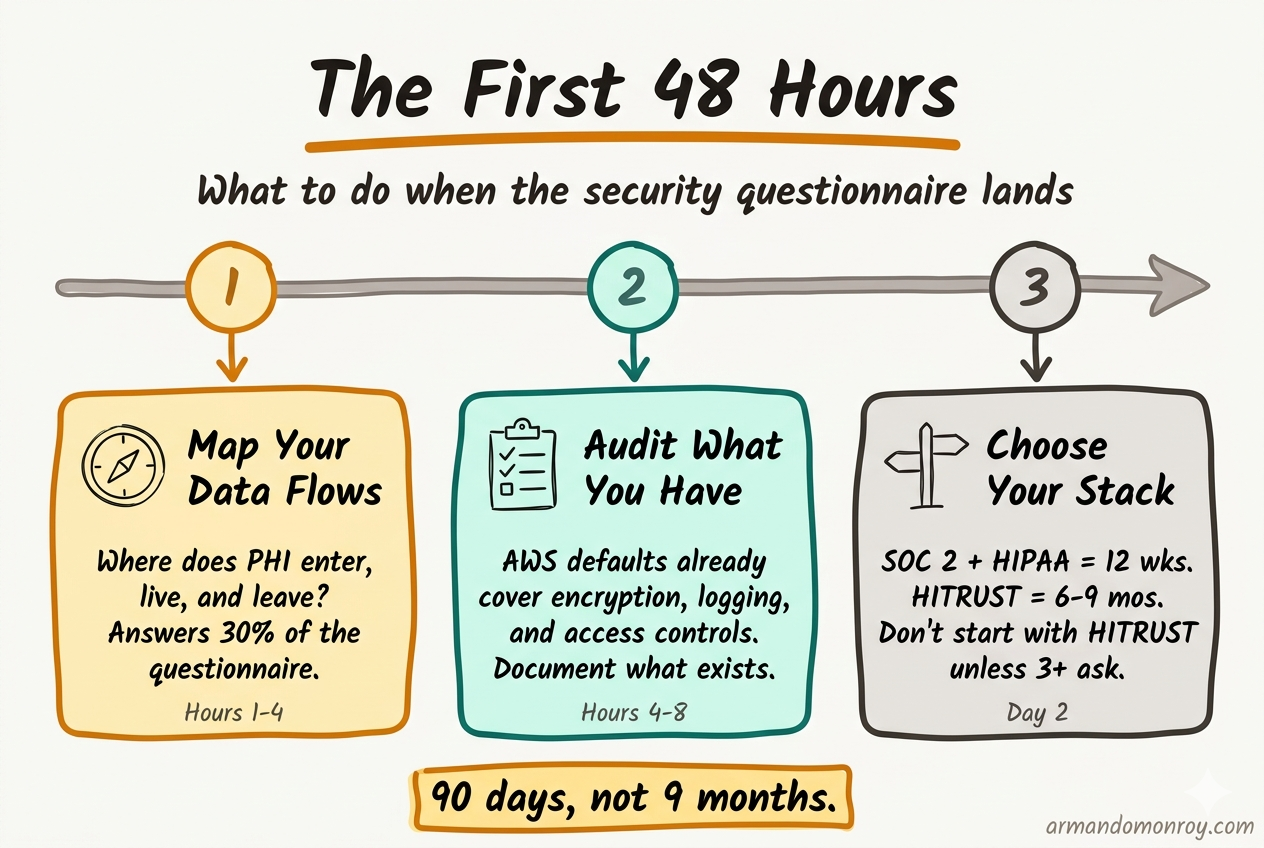
The first 48 hours: what to do when the questionnaire arrives
If you just received that email, here is what matters right now. Not next week. Now.
Hour one: Do not panic, and do not start answering the questionnaire. Your instinct will be to open the spreadsheet and start filling in rows. Resist that. A rushed, incomplete response is worse than a structured one that arrives a few days later. It signals that you do not have a security program, and it creates a paper trail of gaps.
Hours two through four: Assess what you actually have. Take inventory. Written security policies? Multi-factor authentication across your cloud infrastructure? Audit logging turned on? A Business Associate Agreement (BAA) template? Most startups have more than they think, but it is scattered across Google Docs, Notion pages, and Slack threads. Gather it.
Hours four through eight: Scope the gap. Compare what you have against what the questionnaire asks for. Group the questions into categories: access controls, encryption, incident response, vendor management, data handling. Figure out which categories you can answer today and which ones require new work. This gives you a realistic picture of the effort.
Day two: Communicate honestly with the prospect. Tell your champion at the health system that you are taking their security requirements seriously, that you are formalizing your compliance program, and that you will have a structured response within a defined timeline. Most health systems will work with you if you are transparent. What kills deals is silence or vague answers.
Day two: Get help. This is not a DIY project for a company that needs to close a deal. Find a fractional CISO, a compliance consultant, someone who has been through this before. The difference between a guided 12-week process and an unguided 6-month scramble is real. Someone who knows the healthcare compliance space can tell you which controls matter for your specific product, which HIPAA requirements apply to your data flows, and which questions on that 300-row spreadsheet you can answer with documentation you already have.
The framework that works
The healthtech startups that handle this well share a pattern. They build SOC 2 and HIPAA as one integrated program from the start, because roughly 60% of the controls overlap. Access management, encryption, incident response, vendor risk, audit logging. Build them once for both frameworks and you save 30-40% of the total effort compared to bolting HIPAA onto SOC 2 after the fact.
With the right guidance, a Series A healthtech startup can go from zero to audit-ready in 12 weeks, with engineering involvement capped at 2-3 hours per week. That is the difference between closing the deal this quarter and watching it slip two quarters.
The wall is coming either way
Every healthtech startup hits the compliance wall. The companies that come through it cleanly are the ones that see it coming before the email arrives. They invest in compliance infrastructure at Series A, not because it is exciting, but because it removes the biggest source of friction in their enterprise sales pipeline.
If you are a healthtech founder reading this before the wall hits, you have an advantage. Use it. If you are reading this because the email already arrived, take a breath. The path forward is clearer than it feels right now.